Background
Goldenseal, or Hydrastis canadensis, is a terrestrial perennial medicinal herb primarily found in hardwood forests in the eastern part of North America, most notably in the Southern Appalachia Bioregion (Oliver (NatureServe), 2014a). Goldenseal is a slow-growing plant that grows from rhizomes and is wildcrafted for its medicinal benefits and high price on the global trade market (Oliver (NatureServe), 2014a). According to the conservation group, United Plant Savers, “Goldenseal is considered to be one of the most at-risk medicinal plants in the United States and is estimated to be at a high risk of extinction through its native range” (Goldenseal – Hydrastis Canadensis – United Plant Savers, 2019). Goldenseal is dependent on forested areas to thrive and has been in steady decline since the 1800s due to land repurposing, usually for agricultural uses, and overharvesting for medicinal purposes (Albrecht & McCarthy, 2006).
Image 1
Photo of a goldenseal flower. (Hydrastis Canadensis, Goldenseal Flower, Howard County, MD, Helen Lowe Metzman | U.S. Geological Survey, 2019)
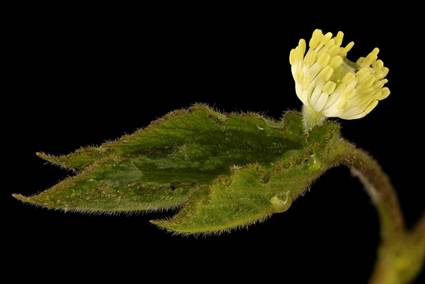
Image 2
Photo Goldenseal patch in a forested area. (Galt-Theis, 2019)

Biological and ecological traits that are relevant to its conservation
Figure 1
Goldenseal classification chart. (USDA Plants Database Plant Profile General, n.d.)
Goldenseal thrives in forested areas with a consistent canopy, as it needs shade to grow, and is found in the eastern half of North America, including the Southern Appalachia Bioregion (Oliver (NatureServe), 2014a). Goldenseal prefers fertile, well-drained soil that is not overcrowded to allow for aeration, reproduces both sexually and asexually, and the rhizome produces clonal stems called ramets (Goldenseal – Hydrastis Canadensis – United Plant Savers, 2019). Research has been conducted into the prevalence of different genetic strains as part of conservation efforts (Sinclair et al., 2005). The flowers of goldenseal appear in the early summer, from April through May, and both vegetative and sexual growth occur (Oliver (NatureServe), 2014b).
Figure 2
Goldenseal’s distribution map. (Oliver (NatureServe), 2014a)

Conservation issues
Goldenseal is listed as vulnerable on the IUCN Red List of Threatened Species, though this may need to be updated. Certain areas, such as in Ohio, highlight that Goldenseal populations are considered endangered, with some genetic variations being extinct (Christensen & Gorchov, 2010; Goldenseal – Hydrastis Canadensis – United Plant Savers, 2019). In 1997, H. canadensis was added to Appendix II of the Convention on Trade in Endangered Species, resulting in a permitting process for possession and trade (Oliver (NatureServe), 2014a). Goldenseal can be cultivated, though its cultivation is often less successful than that of wild species, and there is no regulation on wild harvesting within the United States (Oliver (NatureServe), 2014a).
Goldenseal is a highly valued medicinal plant, sold fresh and dried, often as a powder (Oliver (NatureServe), 2014b). Although some goldenseal is cultivated, most herbal apothecaries carry wildcrafted rhizomes as their main stock (Goldenseal – Hydrastis Canadensis – United Plant Savers, 2019). One study states that the majority of wildcrafted goldenseal is sourced from the Appalachian Bioregion (Christensen & Gorchov, 2010). Here, the nuance of poverty and unemployment plays into the overharvesting of goldenseal, as it fetches a good price for wild harvesters (Goldenseal – Hydrastis Canadensis – United Plant Savers, 2019). In a report prepared for the American Herbal Products Association, goldenseal’s tonnage in 2010 was approximately 50 tons, with 77% of the tonnage wildcrafted (Goldenseal – Hydrastis Canadensis – United Plant Savers, 2019). As a possible alternative, the United States Department of Agriculture (USDA) has a agroforestry handbook that advocates for the woodland cultivation of goldenseal as a cash crop with a landowner making upwards of $6,500 an acre, which could potentially raise awareness about the critical levels the populations are at in Southern Appalachia (USDA Releases Agroforestry Guide for Farmers, Woodland Owners | USDA, 2012).
Threats
Habitat Destruction
Goldenseal needs established forested areas with consistent shaded canopies to thrive. environments. While the original habitat may have long since been destroyed due to land repurposing and development, goldenseal still needs the ability to thrive in whatever habitat remains. Shaded canopies in fertile, well-drained loamy soils recede as the local ecology loses keystone species such as the Eastern Hemlock that contribute to a thriving understory (Eschtruth et al., 2006; Goldenseal – Hydrastis Canadensis – United Plant Savers, 2019). As the market demand grows and the need for cultivation is apparent, botanists question how much suitable habitat there is for a rehabilitation and recovery effort (Albrecht & McCarthy, 2006). Even though goldenseal has been cultivated for over a century and the rhizome responds well to transplanting into forested environments, there is evidence that it is more successful in wild habitats than in cultivation, highlighting the importance of ecological conservation (Christensen & Gorchov, 2010).
Goldenseal’s threatened status is directly linked to habitat loss and destruction caused by land repurposing and overharvesting for medicinal use (Oliver (NatureServe), 2014a). Timber harvests, land and fire management, agricultural repurposing, urban development, sports and recreation, and competition with invasive species are all proximate causes of goldenseal’s population decline(Christensen & Gorchov, 2010). Though there is an argument that the species responds well to soil disturbance, with the successful transplanting of cultivated rhizomes into forested areas as an example, the increase in habitat loss and repurposing has had a substantial effect on populations, resulting in threatened and endangered statuses (Albrecht & McCarthy, 2006).
Overharvest & Exploitation
Assessment of goldenseal population biology was generally unavailable in the United States, with only a handful of studies conducted in Canada (Sinclair et al., 2005). The overall status of populations was based on the need to re-establish them due to depletion caused by over-harvesting for the global medicinal herbal trade (Sinclair et al., 2005). Population measurements were done on the vegetative reproduction, as none of the plants were flowering. Results from a growth study showed that vegetative offshoots had similar survival rates once established as older established ramets, that ramets were not as hardy as older well-established ramets, that all life stages produce offshoots, and that the vigor and number of offshoots were increased with the age and established state of the ramets (Sinclair et al., 2005).
Several medicinal constituents are found in the rhizome of goldenseal, notably berberine, hydrastine, and canadine (Mandal et al., 2020). A growth study showed that an older, more established plant of 5+ years produces 5 times as many rhizomes and biomass as a younger plant (Douglas et al., 2010). The same study found no difference in the amount of berberine content between the roots and rhizomes in the differing years, but that the alkaloid hydrastine showed variation in the older plants, with the rhizomes having a content of 2.25-2.8% as compared to the roots at 1.3% and 1.9%, with overall content being higher seasonally in the early summer (Douglas et al., 2010).
A comparable analysis suggests that goldenseal life cycles are more resilient during overwintering when the rhizome is harvested in the fall, indicating that the plant’s phenology responds accordingly (Albrecht & McCarthy, 2006). There is conflicting information about the harvest of fall rhizomes, with some studies reporting devastating effects on the plant’s overwinter survival (Albrecht & McCarthy, 2006).
As previously stated, some alkaloids are higher in the early summer than in the fall, and the wildcrafters tend to want the supple, dense rhizome of early summer due to its weight (Albrecht & McCarthy, 2006; Douglas et al., 2010).
Poaching is also of concern in Southern Appalachia, as folks dig up the roots under the cover of night to sell on the global market (Goldenseal – Hydrastis Canadensis – United Plant Savers, 2019). A popular herbal apothecary that sells globally, Mountain Rose Herbs, advertises wildcrafted goldenseal powder for $94.00 for a 4-oz bag (Goldenseal Root Powder, n.d.).
Gaps in knowledge
More research is needed in the Appalachian states, and, more importantly, in the Southern Appalachia Bioregion. Much of the data is from Canadian studies, with much of the United States data reported by citizen scientists rather than academic platforms (Christensen & Gorchov, 2010). Biologists, ecologists, and professional foragers need to be defined, and information needs to be shared. Many wild-crafters and herbalists who gather goldenseal for their local apothecaries and for trade in the global market may have insight into growth cycles that an academic biologist, only in town long enough to observe a vegetative growth state, may miss (Christensen & Gorchov, 2010). In turn, local tradition may not hold the same knowledge as a biologist, with data proving that harvest during a “lesser state” may be sufficient for one’s medicinal purposes, and that the larger rhizomes may be so important for survival that they should be forbidden to be touched (Albrecht & McCarthy, 2006).
Overview of Management
Due to the secretive medicinal wildlife trade and the regular use of native wild goldenseal populations, there is no clearly defined management plan for goldenseal (Golden Seal | Mass.Gov, n.d.). Much of the conservation effort has originated with medicinal botanists and foragers who recognize the need for immediate action due to dwindling numbers resulting from overexploitation in the medicinal wildlife trade, including habitat restoration and the reintroduction of populations in overharvested areas (“Goldenseal,” 2022; United Plant Savers, 2019). Recommendations for the conservation of Goldenseal include removing invasive, competitive species, protecting surrounding areas to preserve the much-needed old-growth canopies, and setting harvest limits to protect the endemic wild populations (Golden Seal | Mass.Gov, n.d.; “Goldenseal,” 2022). There is also education and advocacy by herbalists, who distribute goldenseal, to understand the life cycles and the need for forest cultivation to supplement industry demand for the rhizome, which is successful at the grassroots level (Goldenseal Cultivation & Growing Guide). Gaia Herbs, a popular global distributor of herbal supplements, describes the reality of Goldenseal Conservation by identifying that it takes approximately five years for the rhizome to reach potency for the medicinal market, and that, as an herbal steward, there needs to be accountability and action toward a sustainable forest farm model that will preserve the genetics and medicinal value for generations to come (Goldenseal Is at Risk, n.d.). According to United Plant Savers, a pound of goldenseal sold on the medicinal market for $30-$60 requires approximately 30 rhizomes (United Plant Savers, 2019).
In the Southern Appalachia Bioregion, efforts are being made by the Forest Service, U.S Department of Fish and Wildlife, and herbalist conservationists to proactively restore habitat and introduce new populations, which include research done in tandem with academia (Goldenseal Cultivation & Growing Guide. – United Plant Savers, 2020; USDA Plants Database Plant Profile General, n.d.; USDA Releases Agroforestry Guide for Farmers, Woodland Owners | USDA, 2012; Voort et al., 2003).
Old growth canopies that provide shade are needed for Goldenseal to thrive, and management recommendations include prioritizing protecting habitat from logging or impacting the well-drained soil through equipment use in the areas where Goldenseal grows (Golden Seal | Mass.Gov, n.d.; Persons & Davis, 2005). Invasive species and foliage destruction from deer and other wildlife should be considered, and precautions should be taken to trap and remove animals that may be damaging goldenseal populations from grazing, if needed (Golden Seal | Mass.Gov, n.d.; Goldenseal Cultivation & Growing Guide. – United Plant Savers, 2020).
Goldenseal is also regulated under Appendix II of the Convention on International Trade in Endangered Species (CITES), and a permit is required for export and sale to the medicinal market (Persons & Davis, 2005). This has reduced the illegal export of goldenseal, yet domestic sales of wild-harvested goldenseal remain high in the United States, with no regulation (Oliver (NatureServe), 2014a). Additional documentation may be required to demonstrate that it was collected legally, including landowners’ permission, and possibly maps that identify remaining populations (Persons & Davis, 2005; USDA Releases Agroforestry Guide.
Some forest farms that specialize in Goldenseal are advertising a Fair Wild certification that
emphasizes sustainable cultivation and wildcrafting practices for the medicinal wildlife market
(WishGarden Herbs Inc, 2018).
Critique of Current Strategy
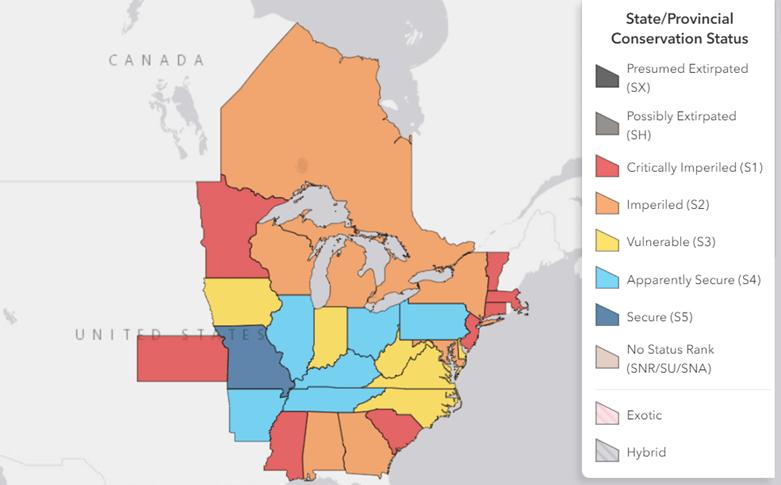
United Plant Savers highlights the need for a Conservation Effort, noting that federal regulations prioritize endangered animals without prioritizing the nation’s endemic flora for protection (United Plant Savers, 2019). There have been conflicting responses, state by state, showing differing numbers from those the government considers threatened or endangered, which complicates Conservation efforts (“Goldenseal,” 2022).
Image 1
Map of Conservation Status of Goldenseal in Eastern North America. (“Goldenseal,” 2022)
Implementation of habitat restoration while identifying next steps to ensure a thriving ecosystem for Goldenseal’s survival is integral, and education needs to be implemented by the same programs that are working to conserve the Eastern Hemlock from the invasive Woolly Adelgid, where the majority of forested areas in the Southern Appalachia Bioregion of Western North Carolina are privately owned, and cannot be federally managed (Golden Seal | Mass.Gov, n.d.; Goldenseal Cultivation & Growing Guide. – United Plant Savers, 2020; Hemlock Restoration Initiative – Returning NC’s Hemlocks to Long-Term Health, n.d.).
Regulation of Goldenseal sales should include domestic trade and should emphasize that local does not always mean safe or sustainable. Much of the local Goldenseal supply in regional apothecaries is wildcrafted in areas where populations are dwindling due to high-unemployment rates, ignorance over the endangered status of the species, and market demand (Goldenseal Is at Risk, n.d.; “Goldenseal,” 2022; Oliver (NatureServe), 2014b). Local cooperative extensions and other agricultural education forums should highlight the need for accountability with local wildcrafting of threatened species.
Image 2
Map of Privately Held Forested Land in North Carolina. (EcoForesters – Forestry. Conservation. Education., n.d.)

Looking Forward: Goldenseal Conservation Reimagined
As we look into an uncertain future of climate-related changes in ecological systems, we must also reimagine new ways to sustain the species that remain and may be needed for survival. Goldenseal is considered an integral medicine that may help fight antibiotic-resistant bacterial strains (United Plant Savers, 2019). Old-growth canopies that provide shade and protection are integral for Goldenseal to thrive in forested areas, and as we have seen in other parts of the world, developing an ecological service program where landowners benefit from not logging or repurposing the land for agriculture may benefit the conservation effort in re-establishing the Goldenseal population (Armsworth et al., 2007; Gaworecki, 2017). This could have a beneficial effect in the Southern Appalachia Bioregion of Western North Carolina, as it could provide needed income that traditionally leads to poached Goldenseal populations, while acknowledging that most forested land in North Carolina is privately owned (Armsworth et al., 2007; EcoForesters – Forestry. Conservation. Education., n.d.; Goldenseal Cultivation & Growing Guide. – United Plant Savers, 2020).
Conservation Strategy Proposal
Many of the concerns about goldenseal being considered threatened and endangered stem from limited DNA variation within populations, due to clonal vegetative growth rather than widespread sexual reproduction via flowers and seeds (Albrecht & McCarthy, 2006; Sinclair et al., 2005; United Plant Savers, 2019). There are multiple issues to address in the approach to conserving goldenseal, and DNA considerations should be highlighted, as they can be quantified and addressed, rather than merely stating that habitat degradation should be limited, which is also true. Loss of suitable habitat is the second leading cause of population decline of goldenseal in its native forested environments of the Eastern United States (Goldenseal – Hydrastis Canadensis – United Plant Savers, 2019). Re-establishing a population with dynamic DNA strains could be a project that could be designed and implemented easily, with research and experience that is currently being done with forest cultivation (Christensen & Gorchov, 2010; Russo & Sweeney, 2000; Sinclair et al., 2005; USDA Releases Agroforestry Guide for Farmers, Woodland Owners | (USDA, 2012). As the Forest Service and the Department of Fish and Wildlife are already highlighting, forest cultivation of goldenseal can mitigate the poaching of wild populations, while still providing income from the largely privately owned forested land (EcoForesters – Forestry. Conservation. Education., n.d.; USDA Releases Agroforestry Guide for Farmers, Woodland Owners | USDA, 2012). Taking this to the next step for a reintroduction and/or protection of DNA variations of wild goldenseal populations, where implementation at Cooperative Extensions and educational platforms that reach farmers, foresters, and landowners could have an impact in reversing the population loss, as well as habitat destruction, as many may not know how to identify goldenseal or know it’s endangered story (Hardin, 1962; Russo & Sweeney, 2000; USDA Releases Agroforestry Guide for Farmers, Woodland Owners | USDA, 2012).
Overharvesting of goldenseal for the international medicinal market is the leading cause of population decline, and regulation under Appendix II of CITES affects only global trade, not the domestic market (Oliver (NatureServe), 2014b; United Plant Savers, 2019). Apothecaries and medicinal plant distributors often carry both cultivated and wild-foraged options, with much of the powder form being wild-harvested (Persons & Davis, 2005; United Plant Savers, 2019). Efforts have been made to protect wild populations of goldenseal by regulating the sale of wild species, but the demand from apothecaries and supplement producers is high, and foragers and herbalists depend on the income for survival (Goldenseal – Hydrastis Canadensis – United Plant Savers, 2019). An education campaign can be developed that informs local forested communities, as well as apothecaries, of the strain on local wild populations and develop an income alternative, as well as a supply solution, that could halt the overharvesting (Goldenseal – Hydrastis Canadensis – United Plant Savers, 2019; United Plant Savers, 2019). This strategy is already in the works in many herbalist hotspots in Southern Appalachia, especially in Asheville, N.C., where there are dozens of herbal apothecaries, businesses, and schools that thrive on local medicinal populations. As I was writing this report, the local global supplement distributor Gaia Herbs posted a video about goldenseal, its threatened status, and their strategy to make goldenseal a sustainable medicinal that will continue to be distributed through their company (Goldenseal Is at Risk, n.d.). Forest cultivation is highlighted as one of the main strategies for the future of goldenseal as a medicinal herb that is distributed from Southern Appalachia (Goldenseal Is at Risk, n.d.; United Plant Savers, 2019). Since much of the land suitable for goldenseal habitat is privately owned, efforts to shift landowners to see goldenseal as a cash crop, only if cultivated, are important in preventing further habitat loss.
References
Albrecht, M. A., & McCarthy, B. C. (2006). Comparative Analysis of Goldenseal (Hydrastis canadensis L.) Population Re-growth Following Human Harvest: Implications for Conservation. American Midland Naturalist, 156(2), 229–236. Academic Search Complete (23337834). https://doi.org/10.1674/0003-0031(2006)156%5B229:CAOGHC%5D2.0.CO;2
Armsworth, P. R., Chan, K. M. A., Daily, G. C., Ehrlich, P. R., Kremen, C., Ricketts, T. H., & Sanjayan, M. A. (2007). Ecosystem-Service Science and the Way Forward for Conservation. Conservation Biology, 21(6), 1383–1384. https://doi.org/10.1111/j.1523-1739.2007.00821.x
Christensen, D. L., & Gorchov, D. L. (2010). Population dynamics of goldenseal ( Hydrastis canadensis) in the core of its historical range. Plant Ecology, 210(2), 195–211. Environment Complete (53021299). https://doi.org/10.1007/s11258-010-9749-2
Douglas, J. A., Follett, J. M., Parmenter, G. A., Sansom, C. E., Perry, N. B., & Littler, R. A. (2010). Seasonal variation of biomass and bioactive alkaloid content of goldenseal, Hydrastis canadensis. Fitoterapia, 81(7), 925–928. https://doi.org/10.1016/j.fitote.2010.06.006
EcoForesters – Forestry. Conservation. Education. (n.d.). Retrieved October 27, 2025, from https://www.ecoforesters.org/
Eschtruth, A. K., Cleavitt, N. L., Battles, J. J., Evans, R. A., & Fahey, T. J. (2006). Vegetation dynamics in declining eastern hemlock stands: 9 years of forest response to hemlock woolly adelgid infestation. Canadian Journal of Forest Research, 36(6), 1435–1450. (21197257). https://doi.org/10.1139/X06-050
Galt-Theis, L. (2019, August 2). Goldenseal – Hydrastis canadensis—United Plant Savers. https://unitedplantsavers.org/goldenseal-hydrastis-canadensis-2/
Gaworecki, M. (2017, October 12). Cash for conservation: Do payments for ecosystem services work? Conservation News. https://news.mongabay.com/2017/10/cash-for-conservation-do-payments-for-ecosystem-services-work/
Golden Seal | Mass.gov. (n.d.). Retrieved February 23, 2026, from https://www.mass.gov/info-details/golden-seal
Goldenseal – Hydrastis canadensis—United Plant Savers. (2019, August 2). https://unitedplantsavers.org/goldenseal-hydrastis-canadensis-2/
Goldenseal Cultivation & Growing Guide. – United Plant Savers. (2020, May 26). https://unitedplantsavers.org/goldenseal-cultivation-growing-guide/
Goldenseal is at Risk: Here’s What Gaia Herbs is Doing to Help. (n.d.). Gaia Herbs. Retrieved February 23, 2026, from https://www.gaiaherbs.com/blogs/seeds-of-knowledge/goldenseal-ethical-harvesting
Goldenseal Root Powder. (n.d.). Mountain Rose Herbs. Retrieved February 2, 2026, from https://mountainroseherbs.com/goldenseal-root-powder
Goldenseal: Sustainability status | Sustainability and social welfare. (2022, January 19). Herbal Reality. https://www.herbalreality.com/herbalism/sustainability-social-welfare/goldenseal-sustainability-status/
Hardin, J. W. (1962). Commercial Herbs, Roots, and Pollens of North Carolina. (Original work published North Carolina State University)
Hemlock Restoration Initiative – Returning NC’s Hemlocks to Long-Term Health. (n.d.). Retrieved October 27, 2025, from https://savehemlocksnc.org/
Hydrastis canadensis, Goldenseal flower, Howard County, MD, Helen Lowe Metzman | U.S. Geological Survey. (2019, December 17). https://www.usgs.gov/media/images/hydrastis-canadensis-goldenseal-flower-howard-county-md-helen-lowe-metzman
Mandal, S. K., Maji, A. K., Mishra, S. K., Ishfaq, P. M., Devkota, H. P., Silva, A. S., & Das, N. (2020). Goldenseal (Hydrastis canadensis L.) and its active constituents: A critical review of their efficacy and toxicological issues. Pharmacological Research, 160, 105085. https://doi.org/10.1016/j.phrs.2020.105085
Oliver (NatureServe), L. (2014a). IUCN Red List of Threatened Species: Hydrastis canadensis. IUCN Red List of Threatened Species. https://www.iucnredlist.org/en
Oliver (NatureServe), L. (2014b). IUCN Red List of Threatened Species: Hydrastis canadensis. IUCN Red List of Threatened Species. https://www.iucnredlist.org/en
Persons, W. S., & Davis, J. M. (2005). Growing & MArketing Ginsing, Goldenseal & Other Wodland Medicinals. Bright Mountain Books, INC.
Russo, M., & Sweeney, J. (2000). Threatened and Endangered Species in the Forests of North Carolina. International Paper Company.
Sinclair, A., Nantel, P., & Catling, P. (2005). Dynamics of threatened goldenseal populations and implications for recovery. Biological Conservation, 123(3), 355–360. https://doi.org/10.1016/j.biocon.2004.12.004
United Plant Savers. (2019, November 1). Hope for Hydrastis [Video recording]. https://www.youtube.com/watch?v=Z4kMYVSEZnI
USDA Plants Database Plant Profile General. (n.d.). Retrieved January 25, 2026, from https://plants.usda.gov/plant-profile/HYCA
USDA Releases Agroforestry Guide for Farmers, Woodland Owners | USDA. (2012, July 16). https://www.usda.gov/about-usda/news/press-releases/2012/07/16/usda-releases-agroforestry-guide-farmers-woodland-owners
Voort, M. E. V. D., Bailey, B., Samuel, D. E., & McGRAW, J. B. (2003). Recovery of Populations of Goldenseal (Hydrastis canadensis L.) and American Ginseng (Panax quinquefolius L.) Following Harvest. The American Midland Naturalist, 149(2), 282–292. https://doi.org/10.1674/0003-0031(2003)149%5B0282:ROPOGH%5D2.0.CO;2
WishGarden Herbs Inc. (2018, January 1). FairWild Foundation. https://www.fairwild.org/all-fairwild-participants/wishgardenherbs

