Author’s Note
I am researching various restoration projects in the Western North Carolina & Southern Appalachia Bioregion. Due to recovery efforts following Hurricane Helene, many restoration projects are underway, yet many are not well-documented for research purposes. There are several organizations participating in a variety of approaches to the conservation and rehabilitation of Tsuga canadensis, or Eastern Hemlock, trees that are in decline due to Adelges tsugae (hemlock woolly adelgid) in the Southern Appalachian Bioregion. The methods range from chemical treatments to genetically modified resistant trees. I am also including an organization that designs stewardship plans as a highlight of what to focus on and learn from in Western North Carolina. I am not an arborist, but the hemlock issue is integral to the regional ecological framework for forest rehabilitation. I am doing an initial summary of local restoration projects in the Southern Appalachia Bioregion, more specifically in Western North Carolina, which is a dynamic version of option A in the syllabus. Instead of doing a deep dive into one project, I wanted to include a few that are working together and rubbing elbows. With local Helene restoration projects running strong with funding finally coming in, one sees the names of Hemlock Restoration Initiative, Forest Restoration Alliance, and EcoForesters on the same projects on the same swaths of land. Understanding how they differ is important to understanding the rehabilitation process itself. I mention mycorrhizal and saprobic fungi as integral to the ecology of T. canadesis stands in Southern Appalachia and how population declines, combined with chemical treatments, contribute to biodiversity loss.
Abstract
The T. canadensis, or Eastern Hemlock, is a keystone species that provides a sustainable habitat and plays an important role in the ecological systems of the Southern Appalachian Bioregion. It has long been a tree that was used by humans for food and lumber. The Eastern Hemlock is home to many species of wildlife, some of which are endangered. The eastern species of reishi, Ganoderma tsugae, thrives specifically on Eastern Hemlock. Populations of T. canadensis are in decline due to an invasive insect infestation called A. tsugae, or the Hemlock Woolly Adelgid (HWA). It has been suggested that the decline of T. canadensis will lead to increased mortality among plants, fungi, and animals, resulting in an overall decrease in biodiversity. Two restoration organizations were reviewed that take different approaches to hemlock rehabilitation. The Hemlock Restoration Initiative provides education and hands-on application of insecticides that people can participate in. The Forest Restoration Alliance collaborates with local scientists and forestry experts to genetically modify seedlings to resist A. tsugae infestations. I also included an organization that participated in land management planning, which is a form of restoration and conservation. Eco Foresters provide education and training to private landowners on how to manage a systemic A. tsugae infestation in T. canadensis stands. Data on A. tsugae fecundity and density correlate with the mortality rates of T. canadensis. Data also show that chemical treatments used to control A. tsugae infestations significantly reduce ectomycorrhizal fungal communities.
Environmental History of Southern Appalachia Highlands: Western North Carolina
Basic Geological Formation
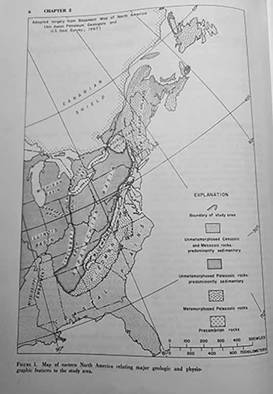
The Appalachian Basin encompasses the Appalachian Mountains and borders the Piedmont, which gives way to the coastal plains on the eastern coast of North America. As you can see in Figure 1, the Appalachian Basin stretched as far north as New York State. This basin is said to be constructed of accumulated sediment left during a time of the separation of land mass and shallow sea water. (Fisher et al., 1970, pp. 6–7).
Terrain of Bioregion
The terrain of the Western North Carolina Bioregion in Central and Southern Appalachia lies between the Piedmont, which serves as the eastern boundary, and the Interior Plateau, which serves as the western boundary (Constantz, 2004, p. 10). The Appalachian Trail acts as a bioregional boundary to the north, and the Blue Ridge Parkway acts as one to the south. The weathered Appalachian Mountains date back to a one-continent state called Rodinia, when Africa and North America collided, creating the Appalachian Mountains (Nomad Press, 2012, p. 13). According to the same source, Geology of the Eastern Coast, “about 750 million years ago, Rodinia thinned and pulled apart… volcanoes erupted, and a deep basin formed along what was then the eastern edge of the continent…which his now western Virginia, North Carolina, South Carolina, eastern Tennessee, and northern Georgia (Nomad Press, 2012, p. 13).”
Figure 1
Map of the Appalachian Basin. (Fisher et al., 1970, p. 6)
Processes and Soil Composition.
The geology of the Central and Southern Appalachian region tends to be comprised of three major types of rocks: metamorphic rock, volcanic rock, and sedimentary rock (Nomad Press, 2012, p. 19). Metamorphic and sedimentary rocks tend to be older and/or have undergone extensive drainage due to weather-related conditions. These geological conditions naturally tend toward acidic, loamy soil. It is worth noting that both acidic and alkaline soils intermingle here.
Flora and Fauna.
The vegetation shifts in direct response to the changes in seasonal temperatures and yearly precipitation. The summer months became warmer, with colder winters and heavier precipitation overall. According to one account based on the Paleoindian and Early Archaic Southeast, “the vegetational matrix was thus changing rapidly, trending from a patchy boreal forest-parkland toward a homogeneous, mesic oak-hickory forest (Anderson & Sassaman, 1996, p. 21).” More specifically, the forests shifted from immature to mature, with dense tree cover. In Figure 2. One can see the change in botanical species and density over time.
Figure 2
Map of the Paleo-vegetation in the Southeastern United States. (Anderson & Sassaman, 1996, p. 5)
Eastern Hemlock (Tsuga canadensis)
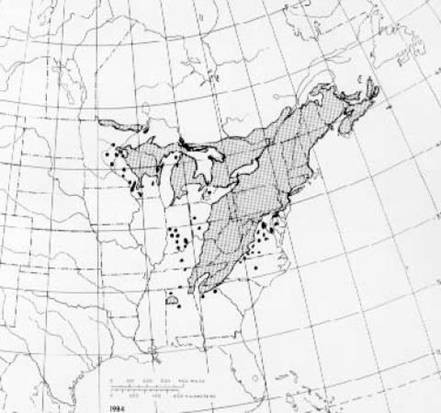
The distribution of Tsuga canadensis extends west to Minnesota and Wisconsin, and as far north as Nova Scotia in the Northeast. It is found in the Southern United States in the Appalachian Mountains and as far south as Alabama. (Eastern Hemlock | Silvics of North America, n.d.)
The Eastern Hemlock is a keystone species that provides a sustainable habitat and plays an important role in the ecological systems of the Southern Appalachian Bioregion. It has long been a tree that was used by humans for food and lumber. The Eastern Hemlock is home to many species of wildlife, some of which are endangered. The eastern species of reishi, Ganoderma tsugae, grows specifically on Eastern Hemlock.
The Eastern Hemlock thrives in the Appalachian Mountain Bioregion and is shade-tolerant. The Southern Highlands of Western North Carolina, with its moist soil and steep slopes, is home to large populations of Eastern hemlock. These trees live more than 500 years when healthy, and can reach heights of 100 ft. (Luray & Us, n.d.; September 05 & 2023, n.d.)
Eastern Hemlock is highlighted for its ability to support a sustainable habitat for mosses and other ecologically important species interconnected with the Southern Appalachian Bioregion.
Figure 3
Photo of a T. canadensis with an A. tsugae infestation in the Appalachian Bioregion. (September 05 & 2023, n.d.)
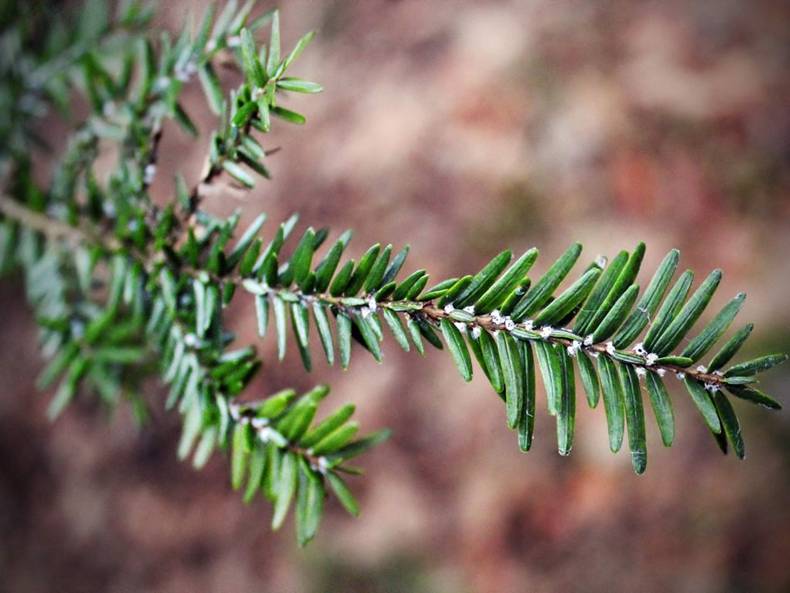
Figure 4
Map of the distribution of T. canadensis, or Eastern Hemlock. (Eastern Hemlock | Silvics of North America, n.d.)
Stressors and Drivers
The stressors affecting T. canadensis include mortality, decreased canopy cover, increased forest-floor temperatures, reduced water availability, destruction of ecological habitat, reduced filtration by riparian buffers, increased sedimentation, and mortality of species dependent on Eastern Hemlock. These stressors are directly associated with some of the drivers, such as the A. tsugae, Hurricane Helene habitat destruction, resource extraction, and environmental pollution.(Baird et al., 2014; Butin et al., 2007; Eschtruth et al., 2006; Narayanaraj et al., 2010)
Hemlock Woolly Adelgid (A. tsugae)
The species T. canadensis has become severely threatened by the invasive Hemlock Woolly Adelgid (A. tsugae). This true bug of the Hemiptera order originated in East Asia and was first documented in 1951. The Woolly Adelgid is a sap-sucking bug that can kill a full-grown healthy tree in 4-7 years after initial infestation. Large stands of Eastern Hemlocks in the Appalachian Bioregion have been decimated by this invasive species. (Hemlock Restoration Initiative – Returning NC’s Hemlocks to Long-Term Health, n.d.; Luray & Us, n.d.)
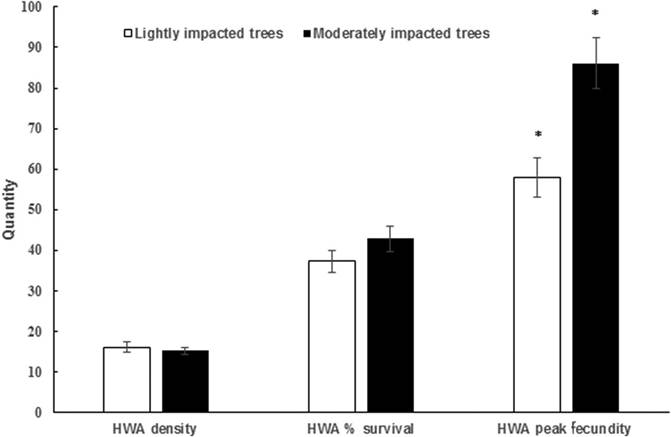
Research has shown that several significant factors in the A. tsugae life cycle can greatly impact the overall health of T. canadensis. Peak fecundity was shown to be the most destabilizing factor to hemlock health, with survival from aestivation and population density also contributing significantly to the decline in hemlock response. I have included a graph from a physiology study on the fecundity of A. tsugae and the mortality rates of T. canadensis. (Jones et al., 2016)
Figure 5
Graph showing correlation between overall density, survival rates, and peak fecundity of the A. tsugae populations and the declining health of the T. canadensis. (Jones et al., 2016)
Restoration & Conservation.
There are several approaches to conservation and rehabilitation that attempt to mitigate the effects of the Hemlock Woolly Adelgid on Eastern Hemlock populations, but the insect’s aggressiveness undermines the tree’s ability to thrive without human intervention and prevention. This poses a serious risk to the ecological systems and other species that need the Eastern Hemlock to survive. There is also a threat of irreversible habitat change due to the loss of the dark, damp Eastern Hemlock understory if mortality rates continue. This could shift the presence of water and the biodiversity of plant and wildlife species in the region.
Hemlock Restorative Initiative.
Hemlock Restoration Initiative – Returning NC’s Hemlocks to Long-Term Health
The Hemlock Restorative Initiative is one of the main organizations that focuses on hemlock rehabilitation in Western North Carolina. There is a systemic problem caused by the hemlock woolly adelgid. This specific project combines community education and volunteerism and advocates for the chemical treatment of hemlocks to conserve them. The Hemlock Restoration Initiative has regular volunteer days that sponsor educational hikes through hemlock forests of the Southern Appalachian Bioregion. The project also hosts workdays where citizen scientists and community members can participate in rehabilitating biodiversity in the region. The group has many partners and works with several Colleges and Universities. (Hemlock Restoration Initiative – Returning NC’s Hemlocks to Long-Term Health, n.d.)
Figure Video 6
Step-by-step instructions on the chemical treatment of hemlock woolly adelgid. (How to Treat Hemlocks for Hemlock Woolly Adelgid, n.d.)
https://youtu.be/sJu77BTzk8w
The Forest Restoration Alliance.
Developing HWA-Resistance/Tolerance – Hemlock Restoration Initiative
This is a group of scientists, researchers, and students interested in using genetic modification to develop resistance to the hemlock woolly adelgid in native hemlocks and related fir species. This group advocates participation without chemical treatment. Here, one sees a dynamic approach to a difficult problem in the Southern Appalachian Bioregion that is thick with debate and research. (Developing HWA-Resistance/Tolerance – Hemlock Restoration Initiative, n.d.-a)
Figure 7
Photo of genetically modified trees at a nursery. (Developing HWA-Resistance/Tolerance – Hemlock Restoration Initiative, n.d.-b)

Eco Foresters.
EcoForesters – Forestry. Conservation. Education.
An organization that is focused on stewardship and rehabilitation through conservation. This project focuses on Helene’s recovery, landowner stewardship, and, specifically, the treatment of invasive species. The project is in Asheville, North Carolina, and focuses on education and stewardship planning, including guidance on navigating harmful invasive species on forested land. This project is valuable because it empowers landowners and citizen scientists to rehabilitate wildlife habitats and assess native and invasive species using GIS and other forestry techniques. I did not find a date or origin, but it looks like the project has been active since 2021. The project is dynamic and ongoing, with layers of education and implementation that enable rehabilitation and conservation. They seem to be a cog in the wheel of getting started with a project if one were to do so on private land. This seems like a common post-Helene situation. (EcoForesters – Forestry. Conservation. Education., n.d.)
Figure 8
Map of Private versus publicly owned forest land in North Carolina. (Landscape Level Forestry – EcoForesters, n.d.)

Response in ectomycorrhizal and saprobic fungal communities
to the Tsuga canadensis chemical treatments
According to data on ectomycorrhizal fungal communities and saprobic fungal species, there was a significant loss of macrofungal communities and diversity among ectomycorrhizal species. This was attributed to chemical root drenches used to treat infected T. canadensis (Eastern Hemlock) stands infested with A. tsugae (Woolly Adelgid). There was also data showing a decline in overall biodiversity, including vegetation, in the surrounding habitat. The study found no significant change in the populations of saprobic fungi, including the medicinal G. tsugae (Eastern Reishi). (Richard Baird et al., 2014; Sturgeon, 2018)
Summary and Next Steps
Mortality in T. canadensis stands in Southern Appalachia from A. tsugae infestation increasingly negatively affects local ecology. Decreased canopy cover, reduced water availability, reduced filtration by riparian buffers, increased sedimentation, fragmentation, and biodiversity loss are all significant factors necessitating restoration and conservation efforts. Several organizations and non-profits are at the forefront of efforts to mitigate the decline of T. canadensis stands due to A. tsugae infestation, including the Hemlock Restoration Initiative, the Forest Restoration Alliance, and the Eco Foresters. Some methods used, such as chemical applications and genetically modified seedlings, are controversial and have been shown to negatively affect local ecology. There are other experimental approaches not discussed in this review, such as introducing a predatory beetle and using mycological insecticides. These experimental approaches may be a logical next step in research, with subsequent recommendations for a study. Negative impacts on mycorrhizal networks and communities may have dire consequences for long-term forest ecology, given the complex relationships that scientists are only now identifying. I included the Eco Foresters organization to show the large private land-ownership education program they offer and how systemic the layman citizen-scientist chemical application regimen can be. Unregulated root drench applications can be detrimental to forest and human health, and I am cautious about this treatment method. Overall, this topic could use more research on the genetically modified organism (GMO) aspect of the Forest Restoration Alliance, including identifying the percentage of endemic versus GMO stands and studying the ecology. I would also recommend working with a mycological organization to discuss the reality and probability of mycorrhizal soil health and the threatened populations of the medicinal G. tsuga as a possible option for future researchand funding for rehabilitation.
References
Anderson, D. G., & Sassaman, K. E. (1996). The paleoindian and early achaic southeast. University of Alabama Press.
Baird, R., Stokes, C. E., Wood-Jones, A., Watson, C., Alexander, M., Taylor, G., Johnson, K., Threadgill, P., & Diehl, S. (2014). A Molecular Clone and Culture Inventory of the Root Fungal Community Associated with Eastern Hemlock in Great Smoky Mountains National Park. Southeastern Naturalist, 13(6), 219–237. (97213359).
Butin, E., Preisser, E., & Elkinton, J. (2007). Factors affecting settlement rate of the hemlock woolly adelgid, Adelges tsugae, on eastern hemlock, Tsuga canadensis. Agricultural & Forest Entomology, 9(3), 215–219. (25764965). https://doi.org/10.1111/j.1461-9563.2007.00334.x
Constantz, G. (2004). Hollows, peepers & highlanders: An appalachian mountain ecology (Second). West Virgina Univarity Press.
Developing HWA-Resistance/Tolerance – Hemlock Restoration Initiative. (n.d.-a). Retrieved October 27, 2025, from https://savehemlocksnc.org/solutions/genetics/developing-hwa-resistance-tolerance/
Developing HWA-Resistance/Tolerance – Hemlock Restoration Initiative. (n.d.-b). Retrieved October 27, 2025, from https://savehemlocksnc.org/solutions/genetics/developing-hwa-resistance-tolerance/
Eastern Hemlock | Silvics of North America. (n.d.). Retrieved November 6, 2025, from https://research.fs.usda.gov/silvics/eastern-hemlock
EcoForesters – Forestry. Conservation. Education. (n.d.). Retrieved October 27, 2025, from https://www.ecoforesters.org/
Eschtruth, A. K., Cleavitt, N. L., Battles, J. J., Evans, R. A., & Fahey, T. J. (2006). Vegetation dynamics in declining eastern hemlock stands: 9 years of forest response to hemlock woolly adelgid infestation. Canadian Journal of Forest Research, 36(6), 1435–1450. (21197257). https://doi.org/10.1139/X06-050
Fisher, G. W., Pettijohn, F. J., Reed, J. C. J., & Weaver, K. N. (1970). Studies of Appalachian geology: Central and southern. John Wiley & Sons.
Hemlock Restoration Initiative – Returning NC’s Hemlocks to Long-Term Health. (n.d.). Retrieved October 27, 2025, from https://savehemlocksnc.org/
How to Treat Hemlocks for Hemlock Woolly Adelgid: A step-by-step guide to soil-based application methods – Hemlock Restoration Initiative. (n.d.). Retrieved October 27, 2025, from https://savehemlocksnc.org/treatment-video/
Jones, A. C., Mullins, D. E., Brewster, C., Rhea, J. P., & Salom, S. M. (2016). Fitness and physiology of Adelges tsugae (Hemiptera: Adelgidae) in relation to the health of the eastern hemlock. Insect Science, 23(6), 843–853. (119752316). https://doi.org/10.1111/1744-7917.12240
Landscape Level Forestry – EcoForesters. (n.d.). Retrieved October 27, 2025, from https://www.ecoforesters.org/landscape-level-forestry/
Luray, M. A. S. N. P. 3655 U. S. H. 211 E., & Us, V. 22835 P. 540 999-3500 E. P. 1-800-732-0911 C. (n.d.). Eastern Hemlock—Shenandoah National Park (U.S. National Park Service). Retrieved October 30, 2025, from https://www.nps.gov/shen/learn/nature/eastern_hemlock.htm
Narayanaraj, G., Bolstad, P. V., Elliott, K. J., & Vose, J. M. (2010). Terrain and Landform Influence on Tsuga canadensis (L.) Carrirèe (Eastern Hemlock) Distribution in the Southern Appalachian Mountains. Castanea, 75(1), 1–18. (51163534). https://doi.org/10.2179/08-049.1
Nomad Press. (2012). Geology of the eastern coast: Investigate how the earth was formed. Nomad Press.
Richard Baird, C. Elizabeth Stokes, Alicia Wood-Jones, Mark Alexander, Clarence Watson, Glenn Taylor, Kristine Johnson, Thomas Remaley, & Susan Diehl. (2014). Fleshy Saprobic and Ectomycorrhizal Fungal Communities Associated with Healthy and Declining Eastern Hemlock Stands in Great Smoky Mountains National Park. Southeastern Naturalist, 13(6), 192–218. https://doi.org/10.1656/058.013.s613
September 05, L. updated & 2023. (n.d.). Tennessee Hemlocks. The Nature Conservancy. Retrieved October 30, 2025, from https://www.nature.org/en-us/about-us/where-we-work/united-states/tennessee/stories-in-tennessee/hemlock/
Sturgeon, W. (2018). Appalachian mushrooms: A field guide. Ohio Univarsity Press.

