by Victoria Camerano
Many of the government websites for the Southern Appalachia Bioregion of Western North Carolina are currently discussing Hurricane Helene recovery, with particular attention given to species like the Gray Bat, or Myotis grisecens (Snapshot: Tropical Storm Helene’s Impacts on Area Bats Slowly Come Into Focus | U.S. Fish & Wildlife Service, n.d.). The Gray Bat is a keystone species as it is a forest builder and acts as insect control, a pollinator, and a seed dispersal (Greene, 2021).The numbers have been reported as down by 25% from a pre-Helene population, with the cause linked to habitat destruction, such as destroyed bridges and flooding of caves (Snapshot: Tropical Storm Helene’s Impacts on Area Bats Slowly Come Into Focus | U.S. Fish & Wildlife Service, n.d.). According to the U.S. Fish and Wildlife Service, “the gray bat was added to the U.S. List of Endangered and Threatened Wildlife on April 28, 1976” (Gray Bat (Myotis Grisescens) | U.S. Fish & Wildlife Service, 2025). The red list last reviewed the Gray Bat as vulnerable in 2017, with there being a need for a reassessment, as the extant habitat was directly in Hurricane Helene’s path through Southern Appalachia, assuming a significant population loss took place (World)), 2017).
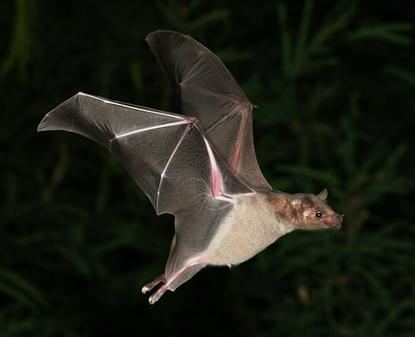
Image 1.
Photo of a Gray Bat. (Gray Bat – Alchetron, The Free Social Encyclopedia, n.d.)
As with other ecological evaluations in the Southern Appalachian Bioregion, the habitats are still in recovery from Hurricane Helene. Due to the significant damage to local terrestrial and aquatic habitats, population counts are difficult to determine as many areas are demolished or inaccessible to biologists. Steps are being taken to include bat habitats in the reconstruction of infrastructure, such as bridges, as a conservation effort (First-of-Its-Kind Bat Habitat Built into I-40 Bridge as Helene Repairs Continue | WATE 6 On Your Side, n.d.). Determining the long term affects of Gray Bat extinction could be estimated as a decrease in plant diversity and an increase in insects that could spread disease in humans, animals, and plants (Gray Bat (Myotis Grisescens) | U.S. Fish & Wildlife Service, 2025).
Image 2.
Photo of the new bat wall installed with the bridge post-Helene. (Service Biologists Discuss a Nearly Installed Bat Wall | FWS.Gov, n.d.)

Summer evenings are defined by the darting of bats looking for bugs in the Southern Appalachia Bioregion. Advocacy through local cooperative extensions and farming programs, such as the Appalachian Sustainable Agricultural Project (ASAP), which could provide specialized classes for farmers in the area (ASAP – Local Food. Strong Farms. Healthy Communities., 2026). Providing free bat boxes and advocating for organic farms to support hosting bat habitat as a way of insect control and biodiversity is a way to reintroduce the species safely.
ASAP – Local Food. Strong Farms. Healthy Communities. (2026, February 13). ASAP Connections. https://asapconnections.org/
First-of-its-kind bat habitat built into I-40 bridge as Helene repairs continue | WATE 6 On Your Side. (n.d.). Retrieved February 16, 2026, from https://www.wate.com/news/top-stories/first-of-its-kind-bat-habitat-built-into-i-40-bridge-as-helene-repairs-continue/
Gray Bat (Myotis grisescens) | U.S. Fish & Wildlife Service. (2025, November 14). https://www.fws.gov/species/gray-bat-myotis-grisescens
Gray bat—Alchetron, The Free Social Encyclopedia. (n.d.). Retrieved February 16, 2026, from https://alchetron.com/Gray-bat
Greene, P. (2021, January 20). 28 Keystone Species Examples Vital to North America’s Ecology. Wildlife Informer. https://wildlifeinformer.com/keystone-species-examples/
Service biologists discuss a nearly installed bat wall | FWS.gov. (n.d.). Retrieved February 16, 2026, from https://www.fws.gov/media/service-biologists-discuss-nearly-installed-bat-wall
Snapshot: Tropical Storm Helene’s Impacts on Area Bats Slowly Come Into Focus | U.S. Fish & Wildlife Service. (n.d.). Retrieved February 16, 2026, from https://www.fws.gov/story/2025-07/snapshot-tropical-storm-helenes-impacts-area-bats-slowly-come-focus
World)), S. S. (IUCN S. B. R. (New. (2017). IUCN Red List of Threatened Species: Myotis grisescens. IUCN Red List of Threatened Species. https://www.iucnredlist.org/en

