by Victoria Camerano
Pueraria montana var. lobata (Willd.)
Maesen & S.M. Almeida ex Sanjappa & Predeep
Ecological & biological traits for success
Kudzu, or Pueraria montana var. lobata (Willd.) Maesen & S.M. Almeida ex Sanjappa & Predeep, is in the Fabaceae family, which encompasses peas and legumes. It is native to Asia and was introduced in the late 19th century as an exotic ornamental plant and was later employed for erosion control. Kudzu is considered an invasive species in North America. It is a non-native species that has shown to cause harm to the ecosystem and the economy. Kudzu is an aggressive invasive that can reproduce both vegetatively and sexually, and its ability to clone itself rapidly with vines producing rhizomes and new runners is one reason it has been successful as an invasive. Kudzu has defined many parts of rural Western North Carolina in the way it crowds out other species and seems to consume plants, trees, buildings, and telephone infrastructure, as seen in Figure 1. (Bentley & Mauricio, 2016; ITIS – Report: Pueraria Montana Var. Lobata, n.d.; Pasiecznik, 2007; US Department of Agriculture: Forest Service Southern Region, 1989)
Figure1
Kuzu invasive species. (US Department of Agriculture: Forest Service Southern Region, 1989)
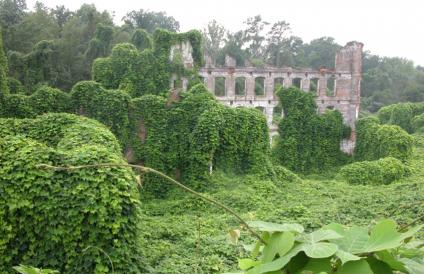
Note. The image above shows how aggressive of an invasive Kudzu is, with it often blanketing an area and choking out native species.
Ecological effects of Kudzu on the ecological systems
The ecological effects of the invasive vining plant Kudzu on the ecosystem threaten native species, plant biodiversity, habitat function, forest infrastructure, and habitat accessibility. The rapid growth rates of Kudzu can dominate a habitat by crowding or choking out native species, leading to the die-off of almost all other species where it has established. (US Department of Agriculture: Forest Service Southern Region, 1989; USDA Plants Database Plant Profile Noxious and Invasive, n.d.)
Figure 2
Mapp of Kudzu invasive species. (Kudzu (Pueraria Montana Var. Lobata (Willd.) Maesen & S. Almeida) – EDDMapS State Distribution – EDDMapS, n.d.)
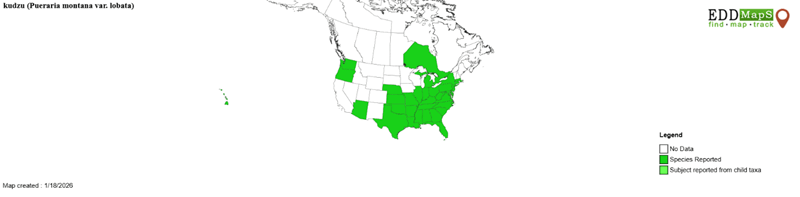
Note. The above image shows areas where Kuzu has taken over. The green areas are the area of the invasive plant’s presence.
Management and potential changes to species life cycles looking forward.
According to the North Carolina Climate Report, there is a projected increase in temperatures due to CO2 emissions from fossil fuels. This will have varying effects in the Southern Appalachian Bioregion, including changing precipitation with predicted less snowfall, but increased rainfall in some areas. Temperatures are predicted to rise, and climate-related events such as wildfires, severe storms, and flooding are also predicted to increase. (North Carolina Climate Science Report: Report Findings and Executive Summary, n.d.)
Kuzu is an invasive plant that thrives in habitats where fragmentation from habitat disruption leads to an edge effect, or a change in species or ecosystem along the edges of an area that has been disturbed. Climate change will increase fragmentation and the effects that will create an ideal habitat for Kudu to establish and dominate native species. Kudzu also prefers warmer temperatures, with sunlight and moderate rainfall, as opposed to hard winters and forest canopy. If left unchecked, the future of local habitats and ecological systems could be threatened by this invasive vining plant that may have an opportunity to establish in ways previously unseen due to habitat alterations from climate-related events, such as substantial landslides seen with Hurricane Helene in Western North Carolina. These landslides created open areas where sunlight could penetrate previously canopied areas while moving plants, trees, animals, and fungi into new locations at a rapid speed. The habitat destruction also made access difficult. These conditions could be ideal for Kudzu to find new habitats in the denser and previously unpenetrated parts of the forest.
Management of this species is integral moving forward. There are many methods, including goat grazing, herbicides, crown removal, and other strategies, employed by the forest service. Identification and early detection are great first steps in the prevention of this invasive taking hold. Education through local forest service offices is a gateway into local management in the Southern Appalachia Bioregion. (US Department of Agriculture: Forest Service Southern Region, 1989)
Figure 3
Photos from Hurricane Helene. (The Road to Recovery on the Blue Ridge Parkway – Blue Ridge Parkway (U.S. National Park Service), n.d.)
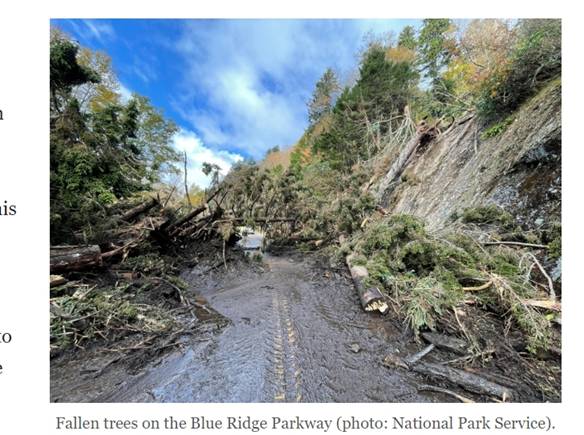
Note. The above photo was taken in an assessment of landslide and fallen trees in the Southern Appalachian Bioregion.
Bentley, K. E., & Mauricio, R. (2016). High degree of clonal reproduction and lack of large-scale geographic patterning mark the introduced range of the invasive vine, kudzu (Pueraria montana var. Lobata), in North America. American Journal of Botany, 103(8), 1499–1507. https://doi.org/10.3732/ajb.1500434
ITIS – Report: Pueraria montana var. Lobata. (n.d.). Retrieved January 18, 2026, from https://www.itis.gov/servlet/SingleRpt/SingleRpt?search_topic=TSN&search_value=529930#null
Kudzu (Pueraria montana var. Lobata (Willd.) Maesen & S. Almeida)—EDDMapS State Distribution—EDDMapS. (n.d.). EDDMapS.Org. Retrieved January 18, 2026, from https://www.eddmaps.org/distribution/usstate.cfm?sub=2425
Native-Land.ca | Our home on native land. (n.d.). Retrieved September 4, 2025, from https://native-land.ca/
North Carolina Climate Science Report: Report Findings and Executive Summary. (n.d.).
Pasiecznik, N. (2007). Pueraria montana var. Lobata (kudzu) (p. 45903) [Dataset]. https://doi.org/10.1079/cabicompendium.45903
The Road to Recovery on the Blue Ridge Parkway—Blue Ridge Parkway (U.S. National Park Service). (n.d.). Retrieved September 30, 2025, from https://www.nps.gov/blri/planyourvisit/the-road-to-recovery-on-the-blue-ridge-parkway.htm
US Department of Agriculture: Forest Service Southern Region. (1989). Vegetation management in the appalachian mountains.
USDA Plants Database Plant Profile Noxious and Invasive. (n.d.). Retrieved January 18, 2026, from https://plants.sc.egov.usda.gov/plant-profile/PUMO/noxious-invasive

