by Victoria Camerano
Cause of Biodiversity Loss: Illegal Wildlife Trade
The illegal wildlife trade is the buying, selling, capturing, poaching, killing, importing, and exporting of species in an illegal manner, and usually with underlying criminal motivations such as profit (Illegal Wildlife Trade and Poaching Explained, 2026; Wildlife Trafficking | ICE, 2025). It has been estimated that $7-$23 billion a year in profits are attributed to the illegal trade of wildlife, which has been identified as one of the most lucrative businesses in the world (Illegal Wildlife Trade, n.d.). Illegal wildlife trade also contributes to biodiversity decline by destroying the ecosystems where the animals are endemic, especially with endangered keystone species that are integral to the natural landscapes and resources (Unsustainable and Illegal Wildlife Trade, n.d.). The increase in biodiversity loss due to illegal wildlife trade is tied to a lack of other sources of income and community pressure from criminal organizations (Nuwer, 2025). Illegal wildlife trade is the second largest cause of biodiversity loss, with habitat destruction coming in at number one (Unsustainable and Illegal Wildlife Trade, n.d.).
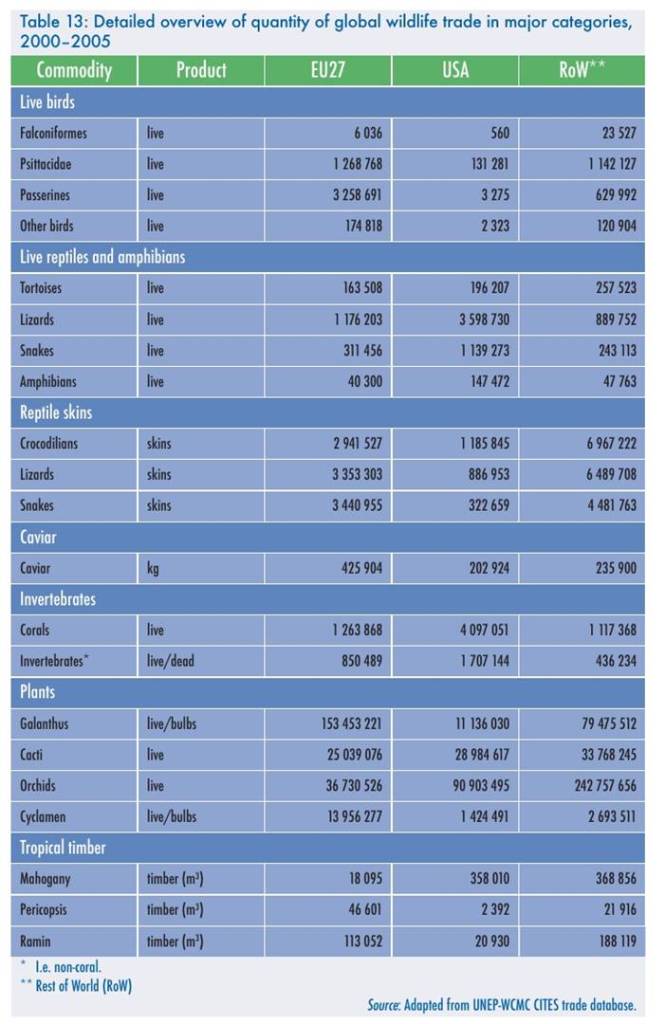
Figure 1.
Chart detailing the global wildlife trade of several wildlife species. (Engler & Parry-Jones, 2007)
Cause and Effects
Causes of the illegal wild animal trade are poverty, loss of historical food systems, academic and medical experimentation, construction, medicinal value, and zoological pursuits. It has been documented that animal parts such as lion cake and ivory have been found in seized illegal drug and gun raids, and that the activity is often related, with funding from one activity supporting the other (Nuwer, 2025). It was estimated that trafficked wildlife was worth over $160 billion, and that the actual number is impossible to predict, as the activity is underground and clandestine (Unsustainable and Illegal Wildlife Trade, n.d.).
Effects of illegal wildlife trade include overexploitation, increasing the threat of extinction (Unsustainable and Illegal Wildlife Trade, n.d.). The removal of species has systemic effects on local ecology that can affect unseen resources needed for human survival, including changes to waterways and deforestation (Illegal Wildlife Trade, n.d.). Often, the profits made from the illegal wildlife trade are funneled into organized criminal networks, strengthening them and furthering the ecological destruction of habitat by species removal (Nuwer, 2025). As stated on the United States Immigration Enforcement (ICE) site, wildlife trafficking causes ecosystem destruction, criminal funding, and stolen tax revenue, which can create economic and political instability in the bioregions where the species are endemic (Wildlife Trafficking | ICE, 2025). The safety of local people is also threatened by illegal activity, especially for activists who resist illegal animal trade. There has been a rise in deaths of environmental activists in Mexico at the hands of a cartel that was directly tied to land and water defense, and arguably directly tied to the protection of wild species that thrive in Mexico (Press, 2022). Illegal wildlife trade affects everyone and should be taken seriously.
Engler, M., & Parry-Jones, R. (2007). Opportunity or threat: The role of the European Union in global wildlife trade. Traffic Europe.
Illegal Wildlife Trade. (n.d.). Global Environment Facility. Retrieved February 9, 2026, from https://www.thegef.org/what-we-do/topics/illegal-wildlife-trade
Illegal wildlife trade and poaching explained. (n.d.). World Wildlife Fund. Retrieved February 9, 2026, from https://www.worldwildlife.org/our-work/wildlife/wildlife-crime/
Nuwer, R. (n.d.). The Illegal Wildlife Trade Is Tied to Drugs, Arms and Human Trafficking. Scientific American. Retrieved February 9, 2026, from https://www.scientificamerican.com/article/illegal-wildlife-trade-tied-to-drugs-arms-and-human-trafficking/
Press, T. A. (2022, September 29). A new report labels Mexico as the world’s deadliest spot for environmental activists. NPR. https://www.npr.org/2022/09/29/1125854118/a-new-report-labels-mexico-as-the-worlds-deadliest-spot-for-environmental-activi
Unsustainable and illegal wildlife trade. (n.d.). Retrieved February 9, 2026, from https://wwf.panda.org/discover/our_focus/wildlife_practice/problems/illegal_trade/
Wildlife Trafficking | ICE. (2025, February 4). https://www.ice.gov/about-ice/hsi/investigate/wildlife-trafficking

